

Skip to content

Trace Element Analysis

Essential micronutrients such as iron, zinc, selenium, iodine and copper — quantified at trace level for nutritional labelling, dietary supplements, fortification control and feed applications under ISO/IEC 17025 accreditation.

Mineral-rich foods with essential nutrient symbols on a wooden table.

Essential Micronutrients –
Small Quantities, Critical Functions

Laboratory chromatography equipment and computer workstation arranged on lab benches.

Trace elements are required in very small amounts but fulfil critical physiological functions. Analytical relevance arises from narrow reference ranges, regulatory labelling thresholds and the need to distinguish adequate supply from deficiency or excess.

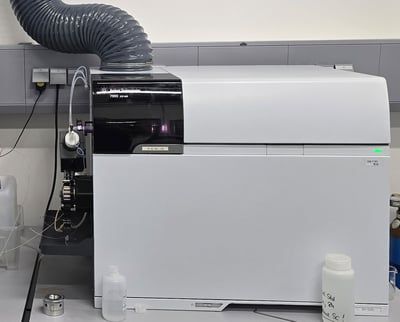
Accurate determination at low concentration levels is essential for nutrition labelling, supplement verification and feed formulation. ICP‑MS enables simultaneous trace‑level quantification across multiple matrices within a single analytical run.

Parameter Portfolio

Quantification of frequently regulated trace elements with established EU NRVs, determined simultaneously for efficient multi-element analysis.

Trace Elements

The most frequently declared and regulated trace elements with established EU NRVs. Relevant for nutrition labelling, health claims, fortification programmes and dietary supplements. All parameters are determined simultaneously by ICP‑MS.

Methods: ICP‑MS, Flame AAS

Common analytes: Iron (Fe), Zinc (Zn), Selenium (Se), Iodine (I), Copper (Cu), Manganese (Mn), Chromium (Cr), Molybdenum (Mo), Cobalt (Co), Boron (B), Lithium (Li), Silicon (Si)


Analytical Methods

Trace elements occur at μg/kg to low mg/kg levels. Method selection focuses on sensitivity, interference control and multi‑element efficiency to ensure accurate quantification at nutritionally relevant concentrations.
Default Platform

ICP‑MS

High‑sensitivity multi‑element determination following microwave‑assisted digestion. Enables simultaneous analysis of trace elements together with macro minerals and heavy metals in a single run.

Suitable for: Iron, zinc, selenium, iodine, copper, manganese, chromium, molybdenum, cobald, boron, lithium

High‑Throughput Screening

Flame AAS

Rapid single‑element determination for trace elements present at higher concentrations. Cost‑efficient option for routine screening.

Element‑Specific Preparation

Alkaline Extraction

Iodine requires alkaline extraction to prevent volatile losses during digestion. Ensures quantitative recovery prior to ICP‑MS determination.

Suitable for: Iodine

Confirmatory Analysis

Graphite Furnace AAS

Electrothermal atomisation provides enhanced sensitivity for selected trace elements. Used as confirmatory or alternative method.

Analytical Interpretation

Trace element results are interpreted against nutritional reference values, regulatory thresholds and product‑specific requirements across food, supplements, feed and specialised nutrition.
Nutrition facts label over fresh salad ingredients.

Nutritional Labelling & NRV Claims

Trace elements must be declared when nutrition or health claims are made. Analytical results are assessed against EU NRVs and evaluated using the EU Guidance on Tolerances.

Typical applications: Packaged foods, nutrition labelling, NRV‑based claims (“source of”, “high in”), product development & reformulation

Organized vitamins and supplements in a transparent pill organizer.

Dietary Supplement Testing

Verification of declared trace element content per daily portion for single‑element and multi‑mineral supplements. Supports batch release, stability studies and consistency monitoring.

Typical applications: Capsules, tablets, powders, liquids

Mother preparing baby formula at home.

Infant Formula

Assessment of mandatory minimum and maximum trace element ranges with narrow acceptance windows. Compositional compliance is safety‑critical.

Typical applications: Infant formula, follow-on formula, food for special medical purposes (FSMP), clinical nutrition

Parrot food seed mix background with sunflower seeds and grains.

Feed Premix & Pet Food

Confirmation of trace element content against guaranteed analysis and maximum authorised contents. Includes verification of premix homogeneity.

Typical applications: Feed premixes, compound feed, pet food (complete & complementary)

Illustration Law

Regulatory Framework

Trace elements occupy a distinct regulatory space: they are essential nutrients with established NRVs and authorised health claims, while some are also subject to maximum levels as contaminants or undesirable substances depending on matrix and use. The analytical result is identical – regulatory interpretation depends on context. UK market: EU‑derived requirements for trace elements apply under UK retained EU law, with assessment against the applicable UK legislation.

Related Analytics

Magnesium chloride crystals with a wooden spoon and glass bowl on a light blue surface.

Minerals

Macro minerals such as sodium, potassium, calcium, magnesium and phosphorus are determined alongside trace elements in the same ICP‑MS run. Combine both for complete mineral profiling within a single analytical program.

Learn More
Water splashing into a natural stream or fountain.

Heavy Metals

Same ICP‑MS digestion and measurement – different regulatory context. Combine trace element profiling with lead, cadmium, mercury and arsenic contaminant screening for supplements and fortified products.

Learn More